
If You Can't See the Field, AI Can't Save You
2 min read • January 31, 2025
David - CEO
We founded ShakeIQ because we kept seeing a gap between what MedTech leaders believed was happening in the field and what was actually happening day to day. The real sales work - key conversations, decisions made in the moment, follow-ups that slipped, customer sentiment - never made it back to leaders.
Details vary, but frustrations are consistent and growing. Leaders want to make better decisions, coach more effectively, and allocate resources with confidence. They need to see what’s happening. To see, they layer processes and administrative tasks - “Put in your data every day!”, “Follow these steps!” - which frustrate and distract reps, leading to disengagement and under-use of company tools and insights.
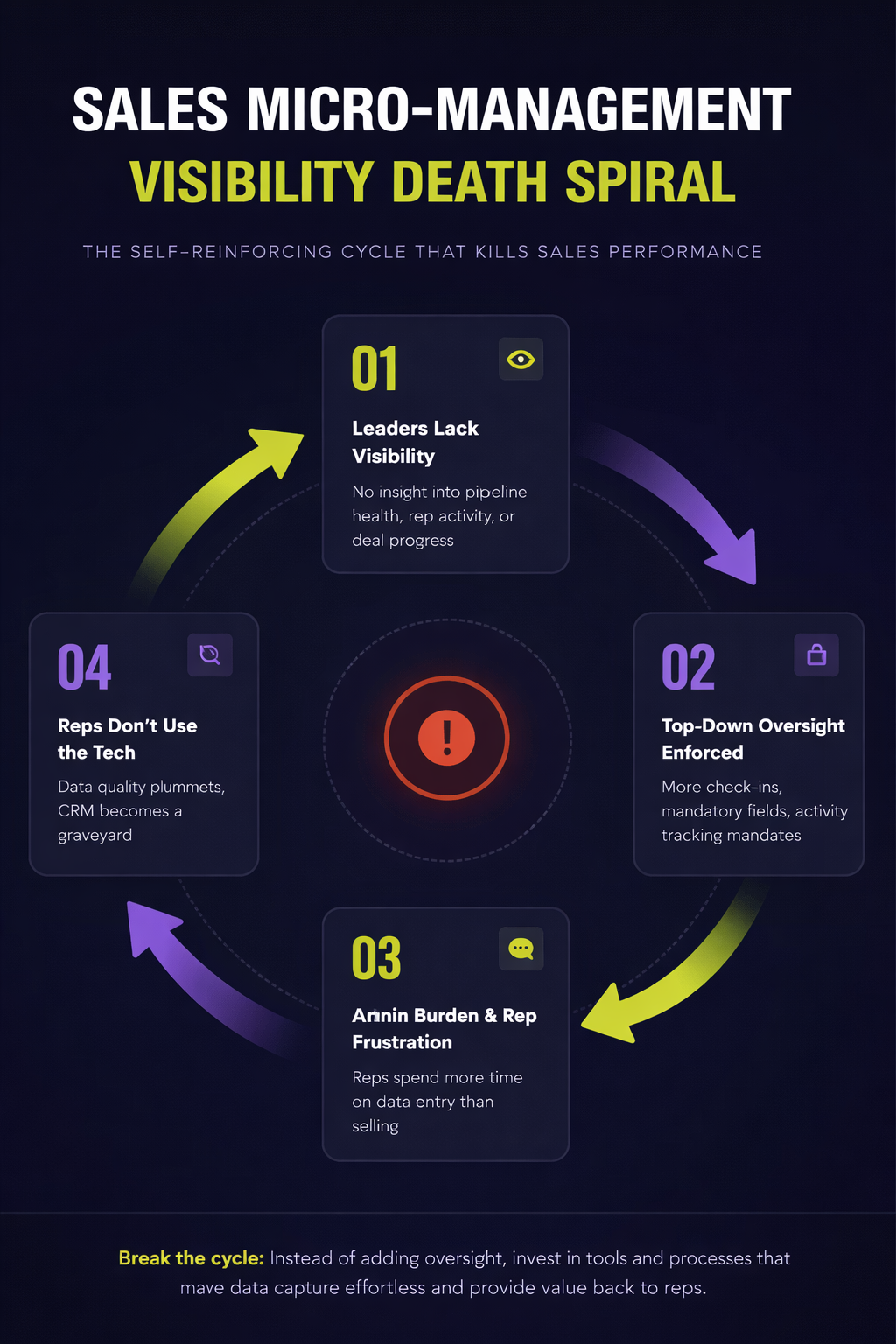
This is the Sales Micromanagement Visibility Death Spiral. Leaders lack visibility → so they enforce top-down oversight → which creates admin burden and drives rep frustration → so reps disengage and don’t use the tech → which further reduces visibility.
Layering AI on top of sales data was supposed to help. The answer, everyone thought, was in the data. So everyone layered AI on top of missing and bad data … accelerating bad decisions and creating even more frustration for Reps.
The initial wave of AI wasn’t meant to break the Micromanagement-Visibility Death Spiral; it was meant to appease leaders looking for anything that could help. But it was a band-aid on a broken arm - and did nothing to address the much deeper issue of visibility.
In the last months the tone has changed. After experimenting with the first wave of AI, leaders are now coming back with the same questions: Why don’t reps use our tech, insights and collateral? Why don’t I have the visibility I need?
There’s a growing recognition that (1) companies with a clear view of what’s happening in the field will pull ahead, (2) Field Salespeople who actually use AI will win over those who don’t, and (3) the window to lead, or even avoid disadvantage is closing quickly. However, even the leaders that see this future are unsure how to make the case for investing in AI that breaks the cycle… because that may require uncomfortable conversations about investments outside of their current commercial technology.
Oleg - CTO
When you look at the Micromanagement-Visibility problem from a technical perspective, the challenge is not a lack of investment. Most MedTech organizations already have more systems, dashboards, and analytics than they can realistically absorb. The issue is where those capabilities sit relative to the actual work being done.
Historically, enterprise technology has been built to create systems of record. CRMs, analytics platforms, and content repositories are designed to store and report on information after the fact. They are good at creating structure, but they are not designed to operate in the middle of a sales conversation or in the moments where decisions and follow-through actually happen.
That separation mattered less when work moved slowly. Today, it matters. Frontline execution is continuous and time-sensitive, while most systems remain episodic and retrospective. The result is a persistent lag between what happens in the field and what leadership can actually see.
What has changed recently is not just interest in AI, but the ability to integrate intelligent action in direct support of the work to be done … instead of bolting it on afterward. AI can now operate across the tools teams already use, applying context, guardrails and action in real time to augment, improve and simplify how reps work - not force more work.
This distinction is critical. AI that monitors action behaves like every other add-on, prodding users to switch context or catch up later. AI that acts to do work supports execution as it happens, captures context naturally, and feeds systems of record without adding burden.
This is the current power of today’s AI - moving from Systems of Record, to Systems of Action. Doing this in a non-hallucinating, explainable, compliant, contextual, personalized, intuitive, user-centric way is the current technical battleground. AI expands what is possible, but only when it reduces friction and turns users into superheroes. When applied as an overlay, it only accelerates visibility gaps and bad decisions. But, when applied well, AI can break the Micromanagement-Visibility spiral.
If this perspective resonates, we’re always interested in comparing notes with MedTech commercial leaders thinking through similar challenges. Enter your email here and our team will get back to you.